Pick Your Feature Wall Based on What the Room Shows You
 Save
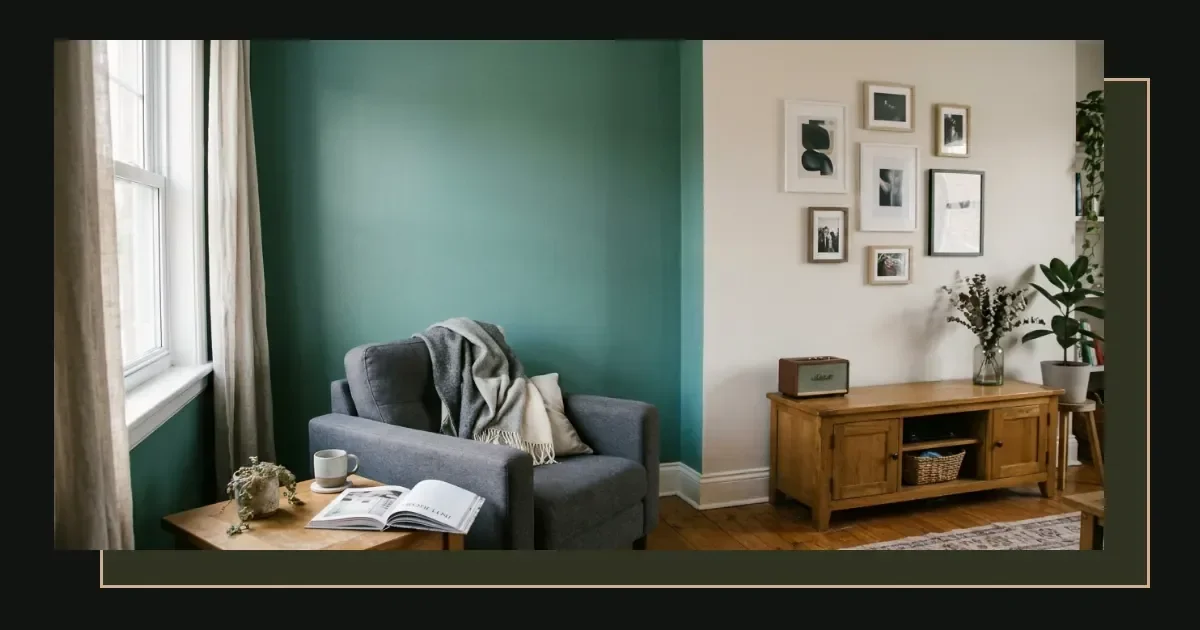
A feature wall works when the room's architecture points you towards it, not when you paint the wall you happen to like best. The right wall is the one your eye travels to when you enter the room, or the surface that already carries the room's strongest architectural detail. Fleur and Grey walks you through reading your room's bones so the painted wall feels like it belongs there.
Why your feature wall looks tacked on
Most feature walls fail because they fight the room's natural structure. Painting the wall behind the sofa sounds logical until you realise nobody looks at that wall — your eye moves to the window opposite, or the doorway that frames the view in. A feature wall on a surface the room doesn't emphasise creates a colour block floating in the wrong place.
The second mistake is painting the longest wall. Length doesn't make a wall important. A short wall with a chimney breast or an alcove has more presence than a flat expanse that does nothing but hold the room up. The feature goes where the architecture already draws attention.
Read the room's focal point first
Stand in the doorway and note where your eye settles. That's your focal wall. It might be the wall opposite the door, the wall with the fireplace, or the wall framing the window. The room has already chosen it — you're confirming what's there.
Architectural features concentrate attention. A chimney breast, an alcove, a picture rail that changes height, a bay window recess — these pull the eye and give the feature wall a reason to exist beyond the colour itself. Painting a featured wall reinforces what the room already does. Painting a flat, featureless wall asks the colour to work harder than it can.
Walk around the room and check the view from each corner. The wall that stays visible from the most positions is your candidate. A wall hidden behind furniture or tucked beside the door disappears from the room's working sightlines.
Test your sightlines from the door
Open the door as if arriving for the first time. The wall directly in your sightline is the reveal wall — the one that announces the room. That's your strongest candidate. A wall to the left or right as you enter gets a weaker view and works only when it carries compelling architecture.
Check proportion and natural light
A feature wall needs enough uninterrupted surface to register as a plane, not a stripe. If the wall is broken by several doors, windows and built-in cupboards, the colour fragments into patches. You want at least half the wall as continuous surface — more is better.
Light changes how colour reads. A wall opposite a window receives reflected light and shows the paint colour more truly. A wall in the darker half of the room — behind the door, or facing away from the window — pulls the colour towards shadow. Test paint samples on both the bright and dim walls before committing. The same paint behaves differently depending on where the daylight falls.
Proportion matters more in smaller rooms. Painting the shortest wall in a narrow room can visually pull that wall forward and balance the space. Painting a long wall in the same room stretches it further and makes the proportions feel more uncomfortable. For advice on working with challenging room shapes, see how to arrange a room with too many doors.
Follow these steps to choose your wall
- Stand in the main doorway and identify which wall your eye reaches first — that wall is the natural focal point.
- Check for architectural features such as alcoves, chimney breasts, or windows that already draw attention to one surface.
- Walk the room and count how many positions give a clear view of each candidate wall — the wall visible from the most places wins.
- Measure the uninterrupted surface on your chosen wall to confirm at least half of it is free from doors, windows and fixtures.
- Tape a large sheet of coloured paper to the wall and live with it for a day to see how the eye travels around the room with that surface emphasised.
Match colour weight to the wall's job
A feature wall works through contrast with the other walls, not through the colour being loud. You can paint a feature wall white in a room of mid-grey and it will still read as the accent surface. The shift in tone creates the feature, not the saturation of the paint.
Darker colours add visual weight and pull a wall forward. Use that on a wall you want to feel closer — the short end of a long room, or a wall you want to anchor the seating around. Lighter colours push a wall back and open the space. A pale feature wall in a small room can make the whole room feel taller if that wall runs floor to ceiling without breaks.
Rooms with strong colour elsewhere — patterned curtains, dark furniture, vivid upholstery — often work better with a muted feature wall that doesn't compete. The feature wall should lead the room's colour story, not fight the other elements for attention. When choosing the exact shade, matching paint to your room's light prevents regret once the tin is open.
Consider what the room is for
A bedroom feature wall usually sits behind the bed because that's the wall you face from the door and the wall that frames the most important piece of furniture. A living room feature wall often works best on the wall behind the television or fireplace — the wall the seating faces.
Avoid painting the window wall unless the window is small and the wall has enough surrounding surface to carry the colour. Painting around a large window creates a frame effect that rarely looks intentional.
Handle awkward rooms with a clear strategy
Open-plan spaces need a feature wall that defines one zone without cutting off the sightline to another. Paint the wall behind the sofa in the living zone, or the wall at the far end of the dining area. Avoid painting a wall that runs between two zones — it emphasises the division instead of anchoring one side.
Rooms with alcoves flanking a chimney breast let you paint just the alcoves and leave the chimney breast neutral, or paint the chimney breast and leave the alcoves pale. Both work, but painting all three surfaces usually makes the feature too heavy unless the colour is soft. In a room that already feels chopped up by architectural detail, less colour often creates more impact. For related layout challenges, softening a modern room without adding clutter shows how to work with clean lines.
L-shaped rooms and through-lounges have two potential focal walls. Pick one and commit to it — painting both creates two competing features and confuses the room's hierarchy.
Compare your options before you start
| Wall type | When it works | When to avoid it |
|---|---|---|
| Opposite the door | Clear sightline on entry, becomes the room's first impression | Wall is broken by multiple windows or lacks enough surface |
| Behind key furniture | Anchors a sofa or bed and frames what the room focuses on | Furniture blocks most of the wall from view |
| Architectural feature wall | Chimney breast or alcove already draws the eye | Feature is small and colour overwhelms the detail |
| Short wall in long room | Brings the far wall forward and improves proportion | Wall is also the window wall and light dilutes the effect |
The right feature wall makes the room feel more intentional. The wrong one makes the whole space look like an unfinished paint job. Trust the room's architecture to show you which wall earns the colour.
#Feature wall #Accent colours #Small rooms #Neutral colours
Download PDF: Feature Wall Decisions Checklist PDF, 29 KB
Further reading
Frequently asked questions
Which wall should I paint as a feature wall in my living room?
Paint the wall your eye travels to when you enter the room, typically the wall opposite the door or the wall behind your main seating. The wall should have a clear, uninterrupted surface and be visible from most positions in the room.
Can I paint the wall with the window as my accent wall?
Only if the window is small and the surrounding wall has enough surface to carry the colour. Large windows break up the painted area into frames that rarely look deliberate, and the natural light can wash out the colour's impact.
What do I do if my room has no obvious focal wall?
Choose the wall directly opposite the door, or the shortest wall if the room feels too long. In rooms with no architectural features, creating a feature wall through colour alone gives the space a focal point it currently lacks.