Arranging cushions on your sofa in 4 practical steps
 Save
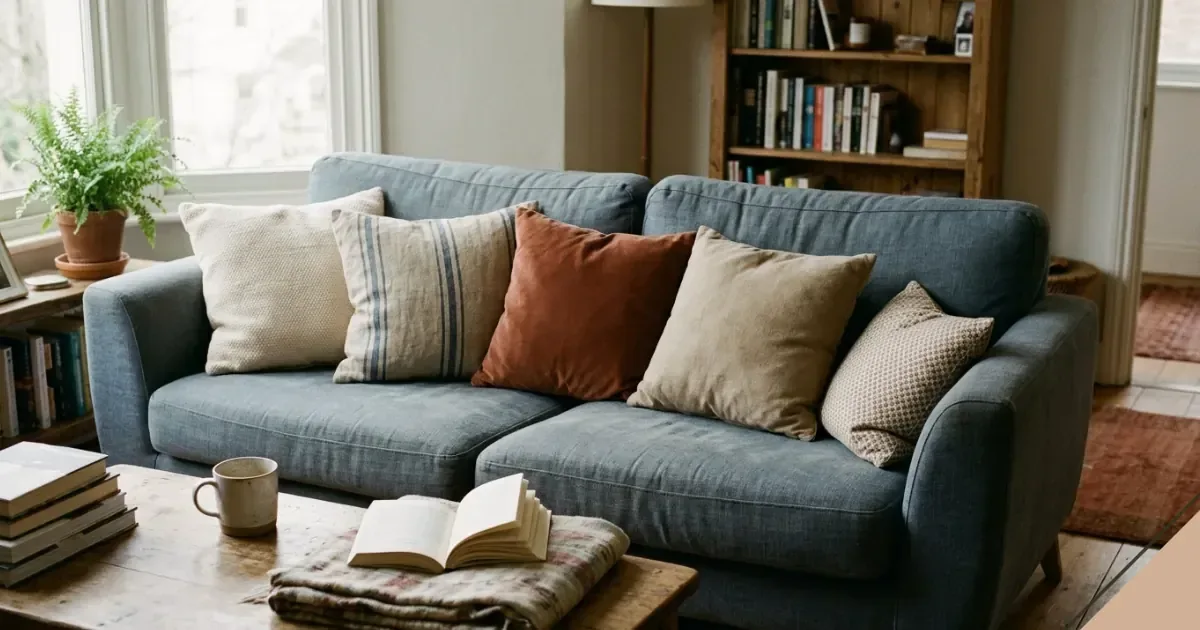
The cushions on your sofa set the tone for the whole room, but most of us either crowd the thing or leave it looking bare. A balanced arrangement comes down to three decisions: how many cushions suit the sofa's size, which dimensions work together and how you layer them. Once you know the formulas, you can dress any sofa in under five minutes. Fleur and Grey walks you through the process, with adjustments for two-seaters, three-seaters and corner sofas.
Starting with the right number for your sofa
A two-seater sofa holds two to three cushions without looking cramped. Three cushions give you symmetry; two let the sofa breathe. A standard three-seater takes four or five: four when you want clean lines, five when you prefer a layered, lived-in feel. Corner sofas vary by their shape, but five to seven cushions usually fill the space without turning the seating into an obstacle course.
Odd numbers create asymmetry that feels deliberate rather than accidental. Even numbers suit formal rooms where symmetry matters. If you share the sofa with someone who treats cushions as a nuisance, lean toward the lower end of the range.
Choosing sizes that sit well together
Mixing two sizes gives you depth without clutter. Pair large square cushions at the back—around fifty to sixty centimetres—with smaller ones in front, closer to forty or forty-five centimetres. The size difference should be noticeable enough that the arrangement looks intentional, not like you ran out of matching covers.
Rectangular cushions work as a third layer or as end pieces on a long sofa. They anchor the corners and stop the arrangement drifting toward the middle. Avoid cushions smaller than thirty-five centimetres square unless the sofa itself is compact: anything smaller disappears into the upholstery.
Layering from back to front
- Place the largest cushions at the back, against the sofa's backrest, one at each end.
- Set medium-sized cushions in front of the large ones, slightly overlapping if the depth allows it.
- Add a single small or rectangular cushion in the centre, or offset to one side if you prefer asymmetry.
- Step back and check the sight line: you should see all three layers without the front cushions hiding the ones behind.
The layers shouldn't form a rigid wall. Let the cushions lean into one another slightly—it softens the look and makes the sofa more inviting. If the arrangement feels stiff, pull one or two cushions forward by a few centimetres.
Picking colours and patterns that hold the scheme together
Start with one solid colour that appears elsewhere in the room—your curtains, a rug or the walls—then introduce pattern through one or two accent cushions. The safest mix is two solids and one pattern for a three-cushion sofa, or three solids and two patterns for five cushions. More than that and the eye struggles to settle.
When you mix patterns, vary the scale: a large floral with a small geometric, or broad stripes with a fine check. Keeping the background colour consistent across the cushions—even if the patterns differ—ties the group together. If the room already carries strong pattern in the wallpaper or upholstery, plain cushions in complementary shades will do more for the space than adding further motifs.
Balancing texture with fabric choice
Velvet cushions add weight and warmth; linen keeps the arrangement light. Mixing the two gives you contrast without reaching for pattern. A wool cushion next to a cotton one achieves the same effect. Avoid pairing fabrics that compete for attention—velvet and sequins, for instance, or heavy brocade with metallic weave.
Texture matters most in rooms with neutral palettes, where colour alone won't create interest. In a space already rich with colour, stick to one or two fabric types and let the hues do the work.
Adjusting the arrangement as the room changes
Cushions shouldn't be a fixed feature. Swap covers when the season shifts: darker, heavier fabrics for autumn and winter, lighter weaves and paler tones for spring and summer. The change signals a refresh without requiring new furniture.
If the sofa sits near a window, direct sunlight will fade covers over time. Rotate the cushions every few months so the wear stays even, or move the most vulnerable ones—those in bright colours or delicate fabrics—away from the sun's path. When a cover loses its shape or the filling flattens, replace it rather than pushing it to the back; a sagging cushion undermines the whole arrangement.
What works and what doesn't: a quick comparison
| Approach | Works when | Struggles when |
|---|---|---|
| All matching cushions | The sofa itself carries pattern or strong colour | The room is plain and needs layering to add interest |
| Odd-number arrangement | You want a relaxed, asymmetric feel | The room follows a formal, symmetrical layout |
| Large cushions only | The sofa is deep and you need back support | You want a layered, dressed look |
| Mixed patterns | The walls and floor are neutral | The wallpaper or rug already carries a bold print |
Keeping the arrangement practical
An arrangement that looks perfect but forces you to move six cushions before sitting down won't last. If you use the sofa every day, stick to three or four cushions and position them at the ends rather than across the middle. Save the fuller, five-cushion look for spaces where the sofa is more for show than for sprawling.
Cushions with zips are easier to clean than those with ties or buttons. Removable covers let you wash them when needed, which matters more than aesthetics if you have children or pets. Keeping floors clear of trip hazards applies just as much to scattered cushions as it does to rugs: a cushion that slides off the sofa every evening is a maintenance problem, not a decorative asset.
Storing spares without adding clutter
If you rotate covers with the seasons, fold the out-of-season ones flat and store them in a drawer or vacuum bag rather than piling them on top of a wardrobe. Cushion pads lose their shape when stacked for months; stand them on edge or hang them if space allows.
Label storage bags with the room and season so you don't waste time hunting through every bag next time you swap. A small habit now saves you an afternoon next spring.
Linking the sofa to the rest of the room
Cushions bridge the sofa and its surroundings. Pull one accent colour from your curtains or artwork and repeat it in a cushion; the repetition ties the room together without requiring matching furniture. If your walls carry a feature colour, echo it in the smallest cushion rather than across all of them—subtlety holds a scheme better than exact replication.
When the sofa sits in an open-plan space, the cushions can mark it as a distinct zone. A warm, textured arrangement signals comfort and draws people toward the seating area, even when the rest of the room serves a different function. Kitchen layouts and living areas each need their own logic, and cushions help define where one ends and the other begins.
Starting today
You don't need to buy new cushions to improve the arrangement. Begin by removing everything from the sofa, then put back only the pieces that suit its size and your daily use. If you're left with too few, one or two well-chosen additions will finish the look. The aim is balance, not abundance.
- Count the cushions you have now and compare that number to the formula for your sofa's size.
- Group them by dimension and pick the two sizes with the clearest difference.
- Layer them back to front, largest at the rear, and adjust until the sight line shows all three layers.
- Stand in the doorway and check whether the colours connect to something else in the room; if they don't, swap one cover.
This page is for general information only.
Download PDF: Cushion arrangement checklist PDF, 30 KB
Frequently asked questions
How many cushions should you put on a three-seater sofa if you want it to look balanced but not overcrowded?
Four or five cushions suit a three-seater: four for a streamlined look, five for a fuller, layered arrangement. Odd numbers create asymmetry that feels intentional; even numbers work better in formal settings.
What sizes of cushions work together when you're mixing them on one sofa?
Pair large square cushions of fifty to sixty centimetres at the back with smaller ones of forty to forty-five centimetres in front. The size difference should be obvious enough to look deliberate. Rectangular cushions work as end pieces or a third layer.
How do you stop a cushion arrangement from looking too stiff or formal?
Let the cushions lean into one another slightly instead of lining them up in rigid rows. Pull one or two forward by a few centimetres so the layers overlap naturally. The arrangement should look inviting, not like a display you're not allowed to touch.