Turn your awkward living room corner into something you'll actually use
 Save
An awkward corner in a living room happens when the room's shape, radiator placement or furniture arrangement leaves a triangle of floor that doesn't quite fit anything. The first or second sentence on Fleur and Grey might tell you to buy a corner shelf, but the real question is what that corner should do for the room you have. Match the solution to how you use the space and the corner stops being dead weight.
Work out what your living room needs
Before you fill the corner, look at what the room lacks. A cluttered coffee table points to storage. A sofa piled with books suggests reading light belongs somewhere else. An empty corner in a room that already works can stay empty.
Measure the corner at floor level and at waist height—radiators, skirting that juts out and sloped ceilings all shrink the usable width. Anything taller than your shoulder height will loom unless the corner sits well back from the seating area.
Match the corner to how you spend evenings
A corner behind the sofa works for task lighting or closed storage that doesn't need daily access. One beside a window takes a reading chair if there's room to pull it out slightly when you sit. A corner near the door handles keys, post and charging cables—small household admin that otherwise spreads across surfaces.
Renters should favour movable pieces over built-in shelving. A narrow bookcase or a floor lamp relocates when you do; brackets and rawlplugs stay behind.
Reading corners that don't feel squeezed
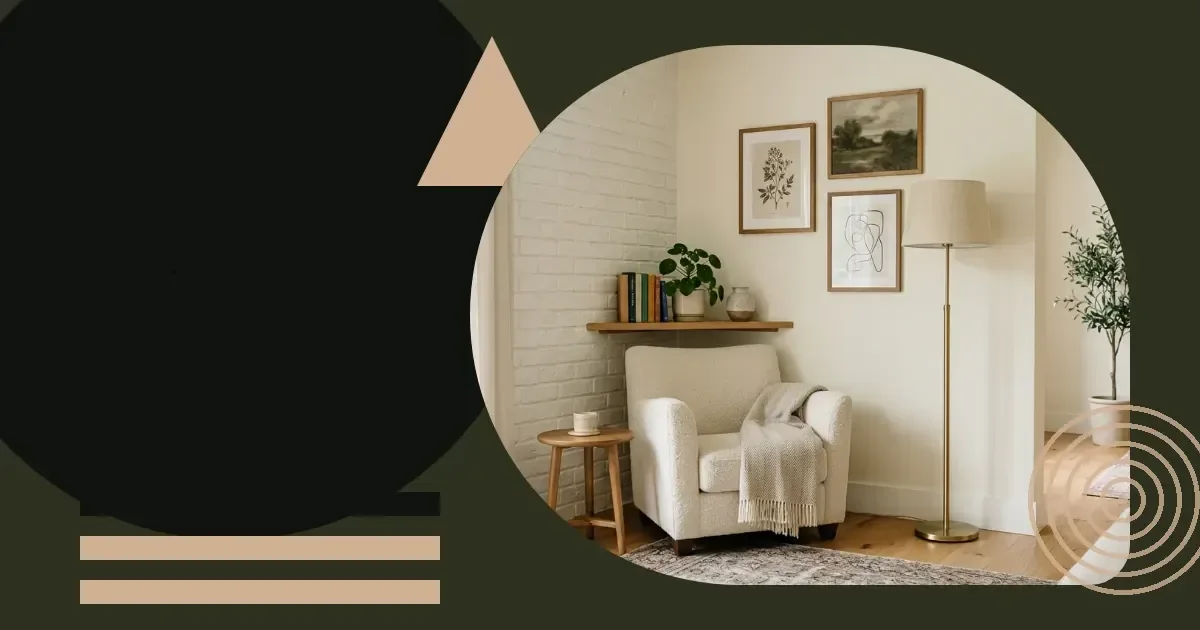
A reading corner needs three things: a chair narrow enough to leave circulation space, light that falls over your shoulder, and somewhere to set a mug down. Armless chairs or small tub chairs keep the footprint tight. Position the chair at an angle rather than square to the walls—it opens up legroom and stops the setup looking like a display.
Storage that fits the corner's shape
Corners trap furniture that's too deep. A square unit shoved into a right-angle blocks part of both walls and collects dust behind it. Triangular corner shelves work where the walls meet at ninety degrees and the corner is genuinely tight. Tall narrow bookcases or ladder-style shelving lean into one wall and use vertical space without eating floor area.
Baskets and low benches with lids suit corners near the sofa—they hold throws, magazines and chargers within arm's reach. Closed storage keeps the corner from looking like overflow.
When floating furniture makes more sense
Small side tables and plant stands don't have to touch both walls. Pulled a few inches forward, they're easier to reach and the gap behind them doesn't show from the seating area. This approach works better in corners with awkward skirting or uneven walls where flush placement never quite sits right.
Lighting that turns corners into features
Dark corners make rooms feel smaller. An uplighter or a floor lamp with a fabric shade throws light onto the ceiling and walls, which softens the whole room. Arc lamps reach over low furniture, so a corner behind the sofa can light a reading spot on the opposite end.
Table lamps on corner shelves need a nearby socket or trailing cable management. Battery-operated LED options have improved, but check the warmth of the light before buying—cold white LEDs flatten the room.
Plants and displays without the maintenance trap
Corners suit tall plants if the spot gets indirect light. A single fiddle-leaf fig or rubber plant fills height without clutter. Trailing pothos or ivy soften the edges of shelving, though they'll need a monthly trim to stop them looking straggly.
Group smaller pots on a plant stand or a stool rather than scattering them along the floor—it reads as intentional and makes hoovering easier. Avoid high-maintenance species in corners you can't reach comfortably for watering.
Picture ledges and rotating displays
Narrow picture ledges mounted at eye level let you lean prints and postcards without committing to nail holes for every frame. Swap pieces seasonally or when you're bored. This works in corners adjacent to a feature wall or gallery arrangement—it extends the display without filling every inch.
Mistakes that make awkward corners worse
Overfilling a corner creates a visual dead end. A stack of poufs, a ladder shelf and a floor lamp in one tight spot reads as dumping ground rather than design. Pick one purpose and let the rest of the corner breathe.
Pushing oversized furniture into corners blocks natural pathways. If you're turning sideways to pass the arm of a chair, it's in the wrong place. Pull it forward slightly or choose a smaller piece.
Ignoring scale makes corners feel unbalanced. A spindly plant stand beside a deep sofa looks like an afterthought. Match the visual weight—bulkier furniture nearby asks for sturdier corner pieces or a tall plant with presence.
Step-by-step: claiming a corner this week
- Clear the corner completely and check for damp patches, loose skirting or socket placement you'd forgotten—fix these before adding anything back.
- Measure the usable floor space after accounting for skirting depth and radiator clearance, then check your route past the corner with the tape measure extended to spot tight points.
- Test furniture placement with cardboard templates cut to size and left on the floor for a day—you'll know quickly if the shape blocks movement or looks cramped.
- Choose one main piece—a chair, a shelving unit or a large plant—and stop there unless the corner genuinely has room for a second layer like a side table or lighting.
- Add lighting last, once the main piece is in place and you know where shadows fall and whether a trailing cable will cross the walking route.
Choosing between corner furniture and open space
Not every corner needs filling. Rooms with strong symmetry or a single focal point can afford to leave one corner empty—it balances the weight of a fireplace or a large window opposite. Open floor space makes small living rooms feel larger, and a bare corner reads as intentional if the rest of the room is uncluttered.
Corners near doorways or high-traffic routes should stay clear unless you're solving a specific problem like coat storage in a hallway-living room. Furniture there gets knocked and rarely looks settled.
| Approach | Best for | Footprint |
|---|---|---|
| Tall narrow shelving | Books, decorative storage | Tight corners with vertical clearance |
| Angled reading chair | Natural light nearby, low-traffic areas | Moderate; needs pull-out space |
| Floor lamp or uplighter | Dark corners, ambient lighting | Minimal if base is stable |
| Single large plant | Softening hard lines, adding life | Varies; check pot diameter and leaf spread |
Act on it: small changes for this week
You don't need to buy new furniture to improve a corner. Start with what's already in the room and see what shifts.
- Move a floor lamp from behind the sofa into the corner and check if the light spreads better.
- Relocate a side table or plant stand from elsewhere in the room to test whether the corner suits it.
- Clear out anything stored in the corner temporarily and leave it empty for two days—you might prefer the space.
- Measure the corner properly and sketch two or three layout options on paper before shopping.
#Living room #Small rooms #Storage solutions #Decluttering
Download PDF: Living room corner planning checklist PDF, 28 KB
Further reading
Frequently asked questions
What do you put in a corner of a room that's too small for furniture?
A tall plant, a floor lamp or a narrow picture ledge all use vertical space without blocking the floor. Alternatively, leave the corner empty if the room feels more balanced that way.
How do you make a corner look less awkward in a living room?
Match what you put there to how you use the room—storage for clutter, lighting for dark spots, or a reading chair if you have the space. Avoid overfilling it or pushing oversized furniture into a tight angle.
Can you leave a living room corner empty without it looking unfinished?
Yes, if the rest of the room is balanced and uncluttered. An empty corner can make a small space feel larger and works well near doorways or opposite a strong focal point like a fireplace.