Keeping curtains in place when the window's open: five fixes
 Save
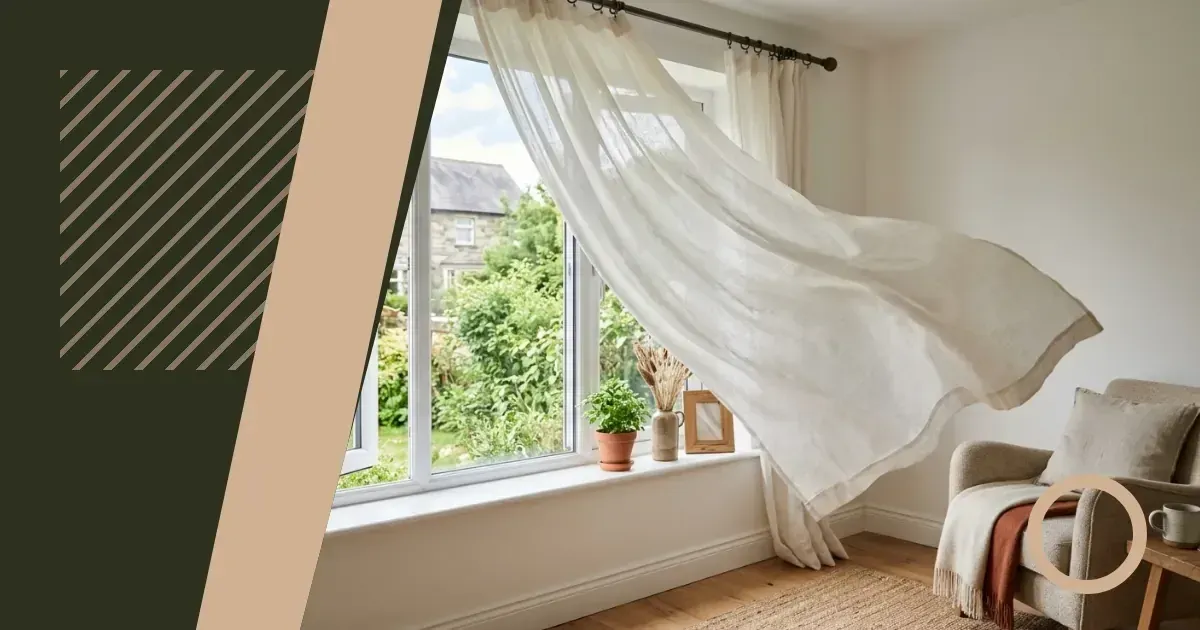
Curtains blowing in from an open window can knock over lamps, scatter papers and flap noisily through the night. The fix is to weight the hem, anchor the fabric at the sides or reduce the breeze coming in—without sealing the room. Fleur and Grey walks through five methods that keep fabric under control while the window stays open.
Adding weight to the hem
The simplest fix is to make the curtain heavier than the breeze lifting it. Curtain weights sit inside the hem at the bottom edge and hold the fabric down. They come as flat discs sewn into pockets, chains threaded through the hem casing, or individual lead weights dropped into stitched corners.
Weights work best on lightweight linen or voile that billows easily. Heavier fabrics—velvet, lined cotton—already have enough mass to resist light draughts. If the curtain has an open hem, unpick a short section at each end, drop a weight into each corner, then stitch the gap closed. For curtains without a hem pocket, sew a small square of fabric around each weight and tack it to the inside bottom edge.
Chains distribute weight evenly across the whole width rather than just the corners. Thread curtain chain through the hem before sewing it closed, or hand-stitch chain tape along the inside bottom edge. The result is a curtain that hangs straighter and resists lifting in the middle where a corner weight would leave it free to flap.
Securing fabric with tie-backs or holdbacks
Pull the curtain to the side and hold it there with a tie-back, and the breeze passes through the centre of the window without catching the fabric. Tie-backs loop around the curtain and fix to a hook on the wall or window frame; holdbacks are rigid arms that hook into the wall and hold the gathered curtain away from the glass.
Position the hook or holdback at roughly two-thirds of the curtain's drop from the floor. Too low and the gathered fabric looks dumpy; too high and the proportion feels off. When both curtains are tied back, the window is fully open and the fabric is out of the breeze path entirely.
This method suits windows where the curtains are drawn back during the day anyway. For bedroom windows that stay curtained at night, tie-backs alone won't stop fabric blowing across the bed once the light is off—combine them with a small weight in each hem corner if the window is open overnight.
Choosing tie-backs that suit the room
Rope, ribbon or fabric tie-backs soften traditional or cottage interiors; metal or wooden holdbacks suit clean-lined or industrial spaces. Match the finish to the curtain pole if one is visible, or to the other metalwork in the room—door handles, radiator valves—if the pole is hidden by a pelmet or heading tape.
Fitting magnets to the curtain edge and sill
Small magnets sewn into the hem and placed on the windowsill pull the fabric down and hold it against the frame. The window can stay open at the top or side, and the weighted hem stays put. This works particularly well on sash windows where the bottom sash is fixed and the top is open for ventilation.
Sew a magnet into a fabric pocket at each bottom corner of the curtain, then place a matching magnet or a steel washer on the sill or frame directly below. The two attract and hold the fabric in place. Use neodymium magnets—stronger than ceramic or ferrite—and test the hold before sewing them in permanently. A curtain that can be lifted by a light tug is easier to open when needed; one that needs force to detach will tear the fabric over time.
Magnets are invisible from the front and leave no mark on rented walls. They suit lightweight fabrics on narrow windows where the wind direction is predictable. On wide windows or in gusty conditions, magnets at the corners alone may not stop the middle section lifting.
Reducing the draught at the window
If curtains are blowing in because the breeze is strong, addressing the airflow can be more effective than fighting it with weights. Open the window at the top rather than the bottom: warm air leaves and cooler air enters higher up, and the curtains hang below the opening. On a sash window, drop the top sash and leave the bottom one closed. On a casement, fit a vent or open a smaller top light if the design allows.
Trickle vents—small openings in the window frame fitted with adjustable flaps—provide continuous background ventilation without the gust of a fully open window. They are common on double-glazed units installed after building regulations tightened. Open the trickle vent and leave the main window closed, and the curtain fabric stays still while the room breathes.
For rooms that need more airflow than a trickle vent provides, open windows on opposite sides of the space to create cross-ventilation. The breeze moves from one opening to the other rather than circulating near the curtains, and the air changes faster so windows can be open for shorter periods.
Adjusting how far the window opens
A window held open a few centimetres creates a steady flow of air without the sudden gusts that lift curtains. Fit a casement stay with notches, or use a sash stop to fix the opening width. Both fittings are screwed to the frame and limit how far the window can move, which also makes the room harder to enter from outside when ground-floor windows are left open overnight.
Tucking the curtain behind furniture or radiators
When a windowsill, radiator or piece of furniture sits directly below the window, tuck the bottom edge of the curtain behind it. The weight of the object holds the fabric down, and no sewing or fitting is needed. This suits rooms where the layout puts something heavy and stable under the window already—a low bookcase, a hall table, a radiator cover.
The curtain needs to be long enough to reach the obstacle without pulling at the heading. Short curtains that end above the sill can't be tucked, and forcing them down will strain the rings or the track. Measure the drop before shortening new curtains: an extra few centimetres at the hem gives the option to tuck when needed.
Radiators present a problem in winter when the heating is on. Fabric tucked behind a hot radiator can scorch, fade or smell of singed fibres. Pull the curtain clear before the heating comes on, or switch to a different method during colder months. If the room layout includes furniture to the side of the window rather than below it—a chair, a small table—draping the curtain behind it at the sides can hold the edges in place while leaving the centre to hang freely.
Combining methods for stronger hold
Light fabrics in draughty rooms may need more than one fix. A curtain with weights in the hem and magnets at the corners will resist stronger gusts than one with weights alone. Tie-backs at the sides combined with a central weight stop the middle section billowing when the edges are held clear.
Test the hold over a few days before committing to permanent changes. Open the window at different times—morning, evening, overnight—and see where the fabric still lifts. Add weight or fixings only where needed rather than along the whole edge. Two corner weights and a tie-back on the windward side may be enough; the lee side may need nothing at all.
Choosing fixes that suit the fabric
Sheer voile and unlined linen respond well to weights and magnets because the fabric is light enough for small fixings to make a difference. Interlined or thermal curtains are already heavy and may not lift much even in a strong breeze—if they do, the problem is more likely to be draught pressure than fabric weight, and adjusting the window opening will help more than adding mass.
Delicate or vintage fabrics should not be weighted with sewn-in lead or chain. The extra strain on old fibres can cause tearing at the stitching line. For curtains that cannot take sewing, use clip-on weights that attach to the hem edge without piercing the fabric, or place weights on the sill and let the curtain rest on top of them.
Patterned fabrics hide stitching lines and small pockets better than plains. Sew weights into the back of a hem on printed linen and the bumps barely show; do the same on plain white cotton and every lump is visible from the front when the light is behind it. Choose flat disc weights for plains and reserve chunkier options for patterns or textured weaves.
Step-by-step: fitting curtain weights into an existing hem
- Measure and mark the position of each weight—one in each bottom corner, or evenly spaced every thirty to forty centimetres along the hem width for full coverage.
- Unpick a small section of the hem stitching at each marked point, just wide enough to slide the weight inside. Use a seam ripper or small scissors and work carefully to avoid cutting the curtain fabric.
- Insert the weight into the hem pocket and push it into the corner or along to the marked position. For corner weights, slide each one as far into the corner as it will go so the hem hangs vertically.
- Pin the opening closed with the weight inside, then hand-stitch the gap using thread that matches the curtain colour. Keep stitches small and even so the repair is invisible from the front.
- Hang the curtain and check the drape. The hem should hang straight and still when the window is open. If one section still lifts, add another weight at that point.
What to avoid
Heavy objects tied to the hem—stones, coins, DIY weights made from wrapped hardware—can tear the fabric or pull stitching loose over time. Purpose-made curtain weights distribute load evenly and are covered or coated to prevent rust and staining. Avoid adhesive weights stuck to the back of the fabric unless the curtain is due for replacement soon; adhesive can fail in warm rooms or leave marks that won't wash out.
Pinning or clipping curtains to the windowsill stops them moving but leaves marks in the paintwork and damages the fabric where the pin pierces it. For rented homes, magnets and weights are reversible and leave no trace when removed. Similarly, resist the instinct to shorten curtains drastically to keep them away from the breeze—too-short curtains make the window look unfinished and remove the option to dress the window formally when needed.
Matching the fix to the room's look
Visible fixes—tie-backs, holdbacks, decorative weights on show—should suit the room's style. Rope and tassel tie-backs fit traditional or maximalist interiors; plain ribbon or leather straps suit modern or minimal spaces. When weights and magnets are hidden inside the hem, no style considerations apply and the fix is led purely by function.
For rooms where curtains are part of a considered scheme, choose fixes that enhance rather than compromise the look. Holdbacks in the same finish as the curtain pole create a coordinated feel; contrasting finishes can add interest if the room mixes metals or periods already. If the fix is purely practical and appearance matters less—a bedroom curtain at night, a kitchen window during cooking—the simplest method is usually the right one.
Taking action this week
Start with what is easiest to test. Open the window at the top instead of the bottom and see if the curtains stay put. If they still blow, pin a small weight into each hem corner temporarily and leave it for a day. The combination that keeps the fabric still without changing the room's look is the one to make permanent.
- Try opening windows at the top rather than the bottom, or reduce the opening width to a few centimetres.
- Test a temporary weight—a large steel washer, a handful of coins in a tied handkerchief—tucked into each hem corner to see if adding mass solves the problem before buying purpose-made weights.
- Pull curtains to the side with a ribbon or cord looped around the fabric and hooked over a picture nail as a trial tie-back.
- Check whether furniture can be repositioned to sit below the window so the curtain hem can be tucked behind it when the window is open.
#Budget decorating #Rental #DIY #Small rooms
Download PDF: Curtain control checklist: stopping fabric blowing in PDF, 28 KB
Further reading
Frequently asked questions
How do I stop lightweight curtains flapping when the window is open at night?
Sew small curtain weights into each bottom corner of the hem, or thread curtain chain through the hem casing before closing it. The added mass holds the fabric down against light draughts without blocking airflow. For a no-sew option, place magnets on the windowsill and sew matching magnets into the curtain hem to hold it in place.
What can I use to weight curtains without sewing anything in?
Clip-on curtain weights attach to the hem edge without piercing the fabric, or you can place loose weights on the windowsill and rest the curtain hem on top. For a quick test, tuck the hem behind a radiator or piece of furniture below the window to see if added pressure stops the fabric lifting.
How do I keep curtains still in a draughty room when the windows need to stay open?
Combine methods—fit weights in the hem and use tie-backs to hold the fabric to the sides, or add magnets at the corners and adjust the window to open at the top rather than the bottom. Reducing the draught by fitting trickle vents or limiting how far the window opens will often work better than trying to hold down fabric in a strong breeze.