Identifying solid wood or veneer in four practical checks
 Save
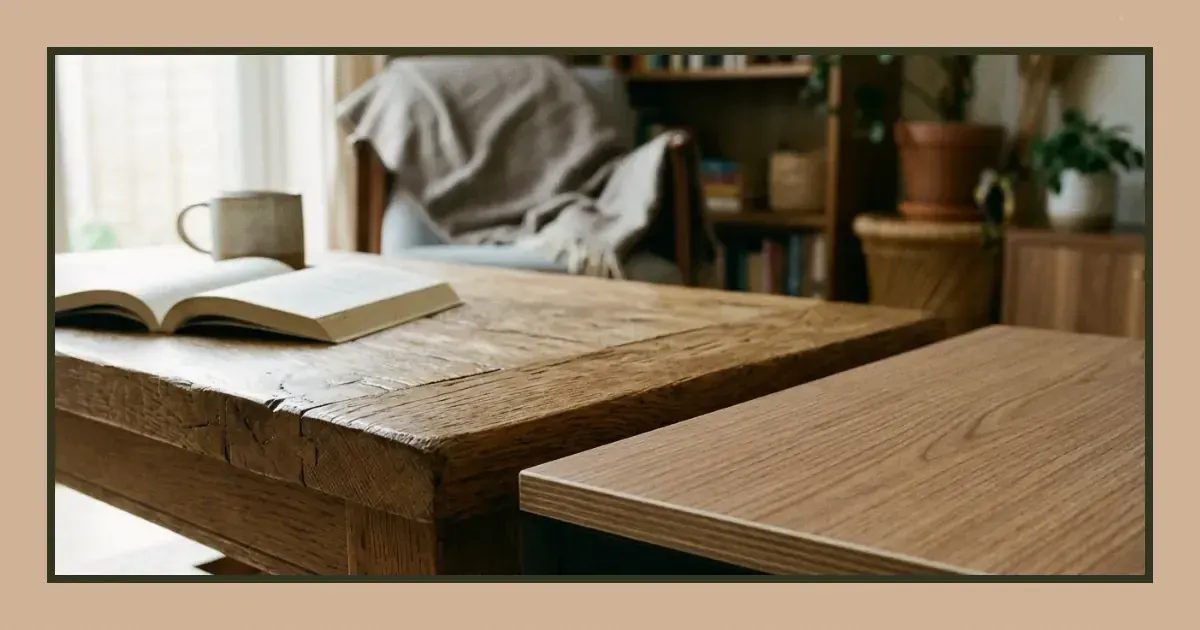
Solid wood and veneer look similar from across a shop floor, but they behave differently under wear, take refinishing differently, and cost differently. The grain pattern, the edges and the weight tell you which one stands in front of you. Fleur and Grey walks through the checks that work before money changes hands.
Looking at the grain on adjacent surfaces
Solid wood shows continuous grain that wraps around corners and edges. Turn a table leg or run your eye along the edge of a drawer front: the pattern flows from one face to the next without interruption. Veneer grain stops at the edge, then starts again on the next surface with a pattern that rarely matches.
Check opposing sides of a door or panel. Solid wood grain mirrors itself — what appears on the front runs through to the back. Veneer shows a different pattern on each face, sometimes a different species altogether on hidden surfaces.
Examining the edges and end grain
The edge of a solid-wood board shows end grain: the small dots or lines where wood cells were cut across. Veneer edges show a thin decorative layer glued to a substrate of plywood, MDF or particleboard. Look closely at drawer fronts, door edges and table aprons.
A veneer edge may be lipped with solid wood to hide the substrate. That lip will be narrow and glued on; the grain direction often differs from the face veneer. On genuinely solid pieces, the edge and the face are one piece with matching grain direction.
Checking for repeating patterns and book-matching
Veneer is sliced thin, so adjacent sheets from the same log produce mirror-image patterns. Two door panels or drawer fronts cut from consecutive veneer sheets will match almost perfectly — desirable in fine furniture but a clear sign of veneer construction.
Solid wood planks vary. Even boards from the same tree show different grain width, colour and figure. If every panel on a cabinet looks nearly identical, veneer is the likely answer.
Feeling the weight and tapping the surface
Solid hardwood furniture is heavy. A dining chair in oak or walnut takes effort to lift. Veneer over MDF or particleboard weighs noticeably less, and veneer over plywood sits somewhere between the two.
Tap the surface lightly with a knuckle. Solid wood returns a dull, dampened sound. Veneer over a man-made core sounds hollow or more resonant, particularly over particleboard. The difference becomes obvious when comparing a known solid piece to a suspect one.
Inspecting seams, joins and patches
Solid wood is rarely wide enough for large surfaces without joins. A tabletop or wardrobe side in solid timber shows edge-glued joints where planks meet. The grain changes direction or width at each join, but the colour and species stay consistent.
Veneer hides substrate joins under a continuous decorative surface. Veneer seams, when present, are hair-thin and placed for symmetry rather than structural need. Patches or repairs that show filler and a thin surface layer confirm veneer over a damaged core.
Steps to check a piece in person
- Run your hand along an edge or corner and look for a change in grain direction. Continuous flow suggests solid; a decorative top layer over something different suggests veneer.
- Crouch down and sight along the surface at a low angle in good light. Veneer shows a uniform sheen; solid wood may reveal planer marks, slight undulations or colour variation within a single board.
- Open drawers and doors to examine the backs and undersides. Solid construction uses the same material throughout, or a secondary timber on hidden parts. Veneer shows plywood or particleboard cores.
- Lift a corner or shift the piece gently if the shop permits. Weight and balance give clues; a lightweight chest in a hardwood finish often means veneer over engineered board.
Recognising quality in both constructions
Neither construction is inherently better. Solid wood can be refinished, bears dents that add character, and lasts decades with care. Veneer over stable plywood resists warping, costs less and allows rare or expensive species to cover large areas.
Quality shows in either form: tight joints, smooth surfaces, veneer without bubbles or lifting edges. Poor execution — loose joints in solid furniture, or peeling veneer on a substrate that swells with moisture — causes the trouble, not the construction method itself.
| Construction | Refinishing | Weight | Stability |
|---|---|---|---|
| Solid hardwood | Can be sanded and refinished multiple times | Heavy | Moves with humidity; may warp or crack |
| Veneer over plywood | Light sanding only; veneer layer is thin | Moderate | Engineered core resists movement |
| Veneer over MDF or particleboard | Cannot refinish; sanding breaks through | Light to moderate | Swells if moisture reaches core |
Asking the seller and reading labels
Descriptions matter. "Solid oak" means the entire piece is oak. "Oak veneer" or "oak finish" means a thin oak layer over something else. "Oak-effect" often means printed laminate rather than real wood veneer.
Ask which surfaces are solid and which are veneered. Reputable sellers specify construction clearly; vague answers or resistance to questions raise doubt. Labels on the underside or back often state materials used for each component.
If the piece is second-hand or vintage, past repairs tell the story. Sanding marks that reveal substrate, or a worn edge showing particleboard, confirm veneer. Deep scratches that show the same wood all the way through confirm solid.
Knowing what matters for your needs
Choose based on how the piece will live. A dining table taking daily wear benefits from solid construction that can be refinished. A wardrobe or bookcase in a stable room performs well in quality veneer and costs less.
Veneer allows complex shapes and matched grain patterns impossible in solid wood. Mid-century and Art Deco furniture often used veneer for visual effect, not as a cost-saving measure. Solid wood suits rustic, farmhouse or traditional styles where texture and patina matter.
Both constructions suit different furniture and budgets. Working out if your sofa deserves reupholstery involves similar checks for frame quality, and knowing what lies under the upholstery helps judge whether the piece will last another decade.
Caring for each type once home
Solid wood tolerates moisture changes better when finished properly. Oil or wax lets the wood breathe; multiple coats of varnish or lacquer protect against spills. Avoid placing solid furniture against radiators or in direct sun, which accelerates movement and cracking.
Veneer needs protection from water at edges and seams, where the substrate can swell. Wipe spills immediately and use coasters. Avoid steam cleaners and saturated cloths. Loose veneer can be re-glued if caught early; once the substrate swells, repair becomes difficult.
Dust both with a dry or barely damp cloth. Polish solid wood with products suited to its finish. Veneer rarely needs more than dusting; excess product can soften adhesive or dull the surface.
#Budget decorating #Storage solutions #DIY
Download PDF: Solid Wood or Veneer: Your In-Shop Checklist PDF, 29 KB
Frequently asked questions
How can I tell if wood furniture is real or fake?
Check the edges and end grain: real solid wood shows continuous grain wrapping around corners and small dots or lines at cut ends. Veneer shows a thin decorative layer over a different substrate. Weight and sound also differ — solid hardwood is heavy and sounds dull when tapped; veneer over man-made board is lighter and sounds more hollow.
Is veneer furniture good quality or should I avoid it?
Veneer can be high quality when applied over stable plywood with tight construction. It resists warping, costs less than solid timber and allows rare woods to cover large surfaces. Poor-quality veneer over particleboard that swells with moisture causes problems, but the veneer itself is not the issue.
Can you sand and refinish veneer the same as solid wood?
Veneer can only be lightly sanded because the decorative layer is thin. Heavy sanding breaks through to the substrate underneath. Solid wood tolerates deep sanding and multiple refinishes over its life.